
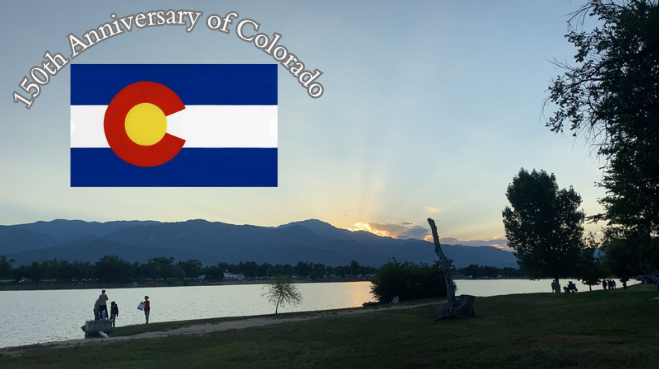
This year is big for the state of Colorado and the United States of America, the two sharing a 100 year age gap. Colorado will celebrate its 150th anniversary into the union on August 1st, 1876, becoming the 38th star on the flag. The US will celebrate its 250th anniversary of independence from Britain this year.
Before Colorado became an official state, it was a part of many different areas, or territories. From the Louisiana purchase in 1803, the US bought the eastern parts of Colorado, and the western parts were snatched up by the treaty of Guadalupe Hidalgo on February 2, 1848, ending the Mexican-American War. These events were about 45 years apart, and gained the land we now know at Colorado. But the Republic of Texas would gain some parts of Colorado, still not fully the rectangle that we know Colorado.
Later on in 1861, President James Bunchman signed legislation forming the Colorado territory. Soon after in 1875, a year before Colorado became a state, Congress would design an act to transition the territory of Colorado into an official state. A year later, President Ulysses S. Grant would make it official, making it the 38th star on the American flag.
What is the history of Colorado before it gained statehood? Many knew about, Colorado even if it wasn’t fully a state. People began settling here in 1858. A decade after the California Gold Rush, the Pikes Peak Gold Rush happened, which would become the second largest mining excitement, right after the California Gold Rush. During the Pikes Peak Gold Rush, Colorado was still a part of the Kansas and Nebraska territory, not even an official state yet. In 1859, the gold rush would be at its peak, with over 100,000 people participating in this gold rush to gain riches. These people would be known as the “Fifty-Niners,” due to the fact it peaked in 1859. Due to the gold rush it would lead for Colorado to create many of its earliest towns, such as Denver, Boulder, Golden, and many small mining towns.
The rapid growth of Colorado due to the Gold Rush helped it become its own territory, and became a state soon after.
But what is the history of the capitals? Denver wasn’t always the original capital of Colorado. There were two other capitals before Denver. In 1861, the first capital would be Colorado City, which is now known as Old Colorado City, neighboring Colorado Springs. It was the capital due to the fact it was centered in Colorado, making it easier for travelers to reach. Although it was only the capital until 1862, later on Golden City, now known as Golden, would be the next capital for Colorado. It was the capital due to its easy access to mining fields and the ability to trade things. Even so, in 1867, it was moved to Denver temporarily, but later when Colorado became a state, it was voted that Denver should be the capital of Colorado. Denver is now the permanent capital of Colorado.
Paul Blakesley lives in Colorado and is a social studies teacher at Palmer High School. He shared that Colorado Spring was founded by General William Jackson Palmer in 1871. Before, it was Colorado City, now known as Old Colorado City, which has served as a mining town. It was a town for miners to set up so they would be able to go into the mountains and mine things.
Palmer was a railroad builder. He decided to build a town separate from Colorado City, and he owned land to build a railroad to go through this town. Palmer envisioned that his town would be like a resort town, so he wanted it to be a place for people to enjoy the outdoors. He donated a lot of land to parks, schools such as Colorado College, Palmer High School, and the School for the Deaf and Blind, and Christian Churches. Palmer wanted Colorado Springs to be a city where families would want to come settle.
He and his wife, Mary Lincoln Mellen, or nickname “Queen,” would start the first school which was named the Colorado Springs School, having Queen be the first teacher. There is currently an elementary school named Queen Palmer Elementary School, to commemorate her. The Colorado Springs School would later become the Colorado Springs High School, then the Old Stone School House, and finally William J. Palmer High School.
Mr. Blakesley shared how there was a disease in the late 1800s to early 1900s called Tuberculosis (TB), which is still around but has a vaccine. Before scientists invented the vaccine, Tuberculosis made breathing very difficult for people, leading them to move to Colorado Springs for the fresh air. A part of town was set up for TB patients. There were one room cabins for them to isolate in, due to the fact it was contagious.
Keith Ferguson was born in a town called Montrose, Colorado. He moved when he was 18, but when he came back to Colorado, it felt like home. This will be his 8th year back in Colorado. He found it hard to live anywhere else but Colorado, from the little towns to bigger cities, and our nature that we have.
Mr. Ferguson provided information about the Colorado Constitution. The Colorado Constitution has been written in Spanish, English, and German. It was written in those three languages because they were the most dominant at the time. Previously, Spanish was the most dominant of the three languages, due to much of Colorado’s land being won from Mexico in the Mexican-American war.
He explained that Colorado’s nickname is not only the Centennial State because it became a state 100 years after the US gained its independence. The other nickname Colorado has is the Switzerland of the US. There is an area called Ouray that is compared to Switzerland and parts of Europe due to its nature. The Great Sand Dunes National Park also have the tallest sand dunes in the US. The Great Sand Dunes’ popularity is derived from its unique nature.
Mr. Ferguson shared that Lincoln Hills is a camping ground that was founded by Regnier and Roger Ewalt to serve as a place to be a resort community for Black Americans to get away from the racism they would face. The resort is located in Coal Creek Canyon which is less than 40 miles west from Denver. It was built to ensure that Black families had access to the outdoors and sends a message that everyone can be together when they are outside.
Another fun place he shared to visit is the Denver Botanic Gardens. The Denver Botanic Gardens are like zoos for plants. The Gardens have a unique variety of plants that are not native in Colorado such as desert plants.
Other ideas for how to celebrate Colorado’s 150th anniversary include visiting a hot springs, skiing, snowboarding, or snow tubing, camping, mountain biking or hiking, or visiting one of Colorado’s many State and National Parks.
Events in Colorado to celebrate the anniversary:
- 250/150 Drone Show: Pikes Peak or Bust Rodeo @ 1045 Lower Gold Camp Rd, Colorado Springs, CO, 80905 on July 16, 2026 (all day event)
- 250/150 Drone Show: Colorado State Fair- Gov wants 2x @ Pueblo, CO on Sep 3, 2026 to Sep 7, 2026 (both are all day events)