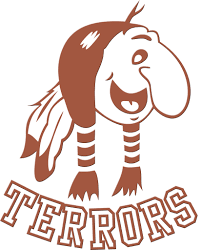
Over the 150 years Palmer has been around, including when it was known as The Old Stone School and CSHS (Colorado Springs High School), Palmer has had a total of four mascots. The most famous one was called Eagle Beak.
A Palmer student, Don Willis, drew an image of a very stereotypical Native American. Depicting a laughing, large nosed Native American, with braided hair and feathers stuck in them. The mascot itself was characterized as a drunken womanizer, and other things that don’t feel all too appropriate for a high school.
“The only thing I do like about the mascot is how original and unique it was, most school mascots are animals but with Eagle Beak everyone knew that it was Palmer,” says Mrs. Fletcher.
The school claimed this image as their mascot in 1945, this mascot was well loved by not only students but so many members of the community.
Due to how long ago the mascot was around and the multiple commenting narratives, we’re still not sure the exact reason or person who planted the seed of doubt in the community that the Eagle Beak mascot was too controversial to keep around. However, we do know that it is still a very personal question to some.
We have to consider that the 1980s was a period of recognition for the multi-cultural society of Colorado, and America in general, and the new generation of that time was beginning to push for respect and equality, some examples being: the Civil Rights movement, Chicano movement, and Native American Identity Awareness.
The controversy of the mascot started in 1985 specifically, the same time as these widespread, student-led, anti-apartheid activism, continued conservative political and social mobilization, the emergence of the environmental justice movement, and activism related to peace and labor in America. People were beginning to realize how stereotypical and overall racist the mascot was.
Palmer was, at first, not aware of the harm caused by the image, but when a Native American rights activism group threatened to take legal action by suing the school over the mascot, they gave in to the pressure to change.
In 1987, about 47 years later, the mascot was changed to the current bald eagle, also known as Eagle Beak 2, we are now more familiar with at Palmer.
Keith Ferguson, is a 9th, 11th, and 12th grade social studies teacher; however, not too long ago he was a fellow student here at Palmer. Going to school here Mr. Ferguson remembers the 1997-2001 Eagle beak 2 mascot, which was around for about a decade.
“Hypothetically, I hope I would have been one of the young white boys of the 80’s to associate with the people pushing to remove harm from our community,” Mr. Ferguson said.
Situations like this, a controversial mascot or racist accusation really are highlight points that show how our generation is very thoughtful and engaged in the world. Transcending political parties empowered to both speak and act on topics of moral distress or instances that don’t align with our collective values as a society such as: climate change, gun laws, or various issues surrounding identity and equality.
Palmer specifically has an established history of student activism, cemented tradition, committed to fighting for what they believe in. In the unlikely event of another conflicting entity it is assumed that the community of Palmer would be the first and largest advocates for a change.
It is fair to assume the people at the time who wanted to keep the mascot were older staff members and/or older members of the community, who maybe grew up with more controversial things like this and didn’t see a problem with it due to the normalization of the mascot.
Trying to understand the perspective of people with unimaginable views is important for historians, we understand mascots are meant to be symbols for a community, we have assumed thus far that the people less willing to change the mascot, felt that way out of fear for the loss of such an old symbol in the community.
“The mascot was defended, most likely, less out of people’s attachment to the culture, but more because of its deep connection to the school and the community,” says Mr. Ferguson